What are AI agents and agentic systems, anyway?
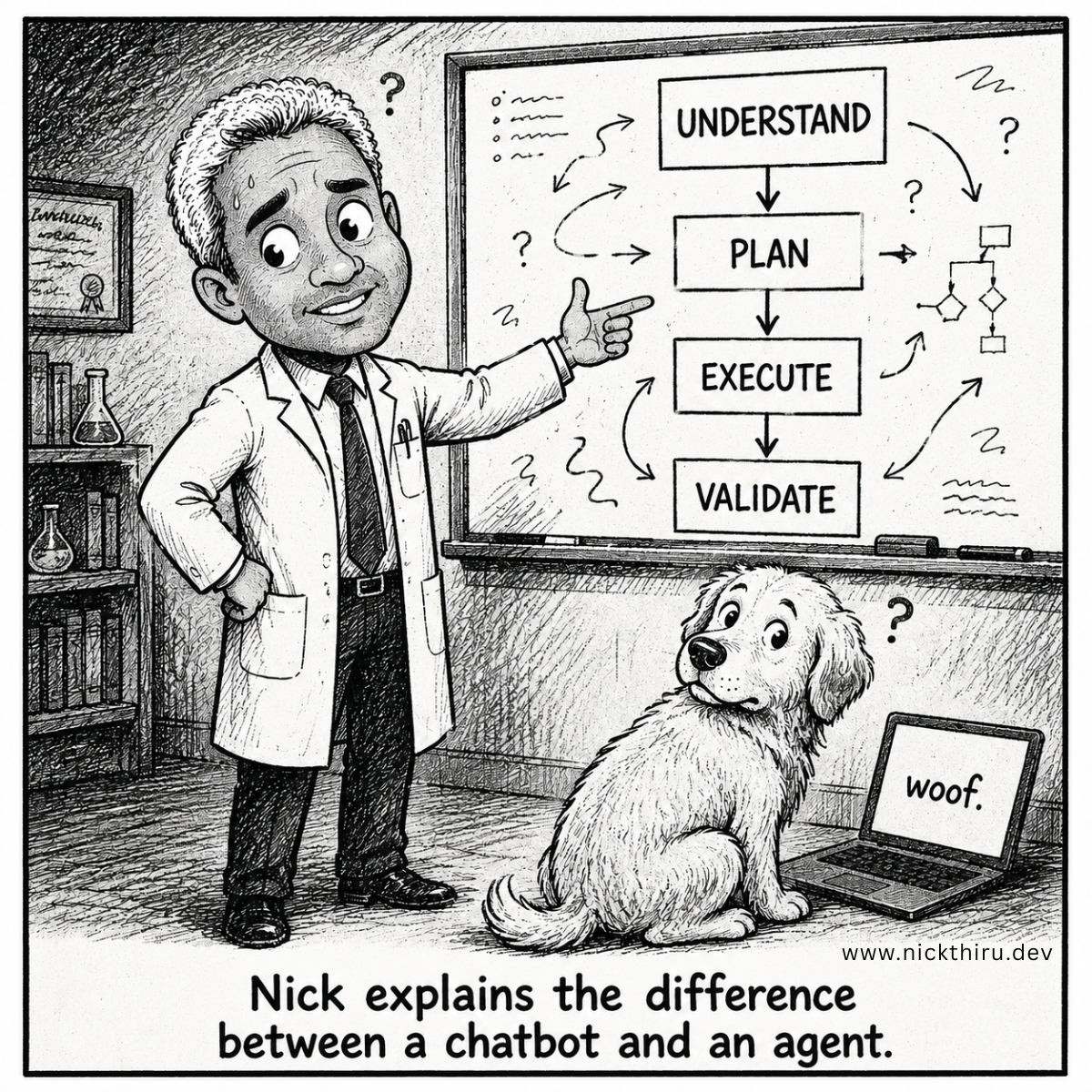
A few times this month someone has asked me, in basically the same tone:
“Wait… what’s an AI agent? Isn’t this just ChatGPT with extra steps?”
Fair question.
Because the internet has done a great job turning the word agent into a vibes-based marketing term.
So let me try to make this simple.
The Short Version
- An AI agent is an AI system that can take multi-step actions to accomplish a goal.
- An agentic system is an application built around agents to handle real workflows end-to-end.
Think: less “chatbot,” more “assistant that actually does things.”
The Core Difference: Questions vs Goals
Here’s the mental model that helped me:
A chatbot
- You ask a question
- It answers
- Done
An agent
- You give it a goal
- It figures out the steps
- It uses tools
- It handles errors
- It returns a result
What I Got Wrong First
When I first started building with agents, I made the mistake most people make: I treated them like very capable chatbots. I focused entirely on what the model could do and almost none on how the system should behave when things went wrong. The first time a tool timed out in production and the agent had no recovery path, I realized I’d been building demos, not systems.
The shift that changed everything was treating the structure as the real product, not an afterthought: state, error handling, observability.
(See: How I structure LangGraph agents for production)
Example: Booking a Flight
Chatbot approach:
You: "Find me flights to New York next week"
Chatbot: "Here are some options: [list of flights]"
You: "Book the 2pm one"
Chatbot: "I can't book flights, but here's a link"
Agent approach:
You: "Book me a flight to New York next week,
     afternoon preferred, under \$400"
Agent:
  1. Searches flights
  2. Filters by your preferences
  3. Finds best option
  4. Books it
  5. Adds to your calendar
  6. Sends confirmation
Result: "Booked! You're on the 2:15pm flight.
         Confirmation in your email."
The key is that the agent does the work, not just the talking.
Key Characteristics of AI Agents
1. Multi-step reasoning
Agents break down a goal into steps and execute them.
Example: “Generate a LinkedIn post from this voice note”
- Transcribe
- Extract key ideas
- Draft 2-3 versions
- Check quality
- Return the best draft
2. Tool use
Agents call APIs and tools.
Examples:
- Search the web
- Query a database
- Send emails
- Trigger workflows
3. Decision-making
Agents choose what to do next based on context and results.
Example: “If quality score is less than 7/10, regenerate with a different angle.”
4. State management
Agents maintain state so they can resume, loop, and avoid repeating work.
5. Error handling
Agents need to recover gracefully.
Because in the real world:
- APIs time out
- tools fail
- users give messy inputs
Real-World Examples
LinkedIn Ghostwriter (what I’m building)
Goal: turn voice notes into authentic LinkedIn posts.
At a high level, it’s an agentic workflow because it:
- Receives a voice note
- Transcribes it
- Analyzes the user’s writing style
- Generates multiple drafts
- Scores each draft (hook, readability, style match)
- Regenerates if the best draft doesn’t meet the bar
Customer support agent
Goal: resolve customer issues autonomously.
A real system might:
- search a knowledge base
- propose a solution
- escalate with context when confidence is low
Code review agent
Goal: review a PR and suggest improvements.
A real workflow:
- reads the diff
- checks for security/performance issues
- runs tests
- writes review comments
What’s NOT an Agent?
A few things people call “agents” that really aren’t:
- simple chatbots
- autocomplete
- classification models
- basic RAG systems (retrieve + generate, but no multi-step action)
Useful tools, but not agentic.
Why Agents Matter Now
Three shifts made agents practical:
- LLMs got better at reasoning
- Tool/function calling became reliable
- Frameworks like LangGraph made control flow and state manageable
The Production Challenge (The Part People Skip)
This is where most teams get stuck.
Demo agent:
- works 80% of the time
- has no observability
- has no quality gates
Production agent:
- works 95%+ of the time
- handles errors gracefully
- logs enough to debug
- validates output quality
- keeps an eye on cost
That gap between demo and production is the real work.
(See: What debugging AI agents taught me about observability)
Getting Started
If you’re thinking about building an agent, here’s what I’d do if I were
starting today:
- Start with one workflow that’s repetitive and rule-based
- Define success clearly (what does “good” look like?)
- Add quality gates before you ship
- Add observability earlier than feels necessary
- Iterate with real users
Your Turn
What’s the most confusing part of the agent hype for you right now — is it the terminology, the gap between demo and production, or something else entirely?
Have thoughts on this? I'd love to hear them. The conversation is happening on: