Building AI Products Solo — And Why It Works
I should probably address the thing a lot of people notice immediately:
I’m building Thiru AI Labs solo.
No co-founder. No team. No “we” behind the curtain.
If you’re evaluating us as a potential solution, it’s fair to wonder whether that’s a red flag. In B2B, team size has traditionally been shorthand for stability.
But here’s the tradeoff I’ve learned the hard way:
team size is a weak proxy for execution capacity when you’re AI-augmented.
And for the kinds of customers I care about most (micro, small, and medium businesses), execution speed and direct access often matter more than headcount.
The stakes
The concern is legitimate. If you’re signing up to build critical operations around a solo-run product, you’re placing a real bet. You need to know whether that bet is reckless or reasoned.
The answer depends entirely on how the work actually gets done. And that’s changed.
The old rules (and why they’re breaking)
A decade ago, solo meant you were constrained by time:
- you could only ship so much
- you could only support so many customers
- you had to choose between building, selling, and operating
AI doesn’t magically remove those constraints, but it changes the math.
I still make every important decision. I still review everything. I still own the outcomes.
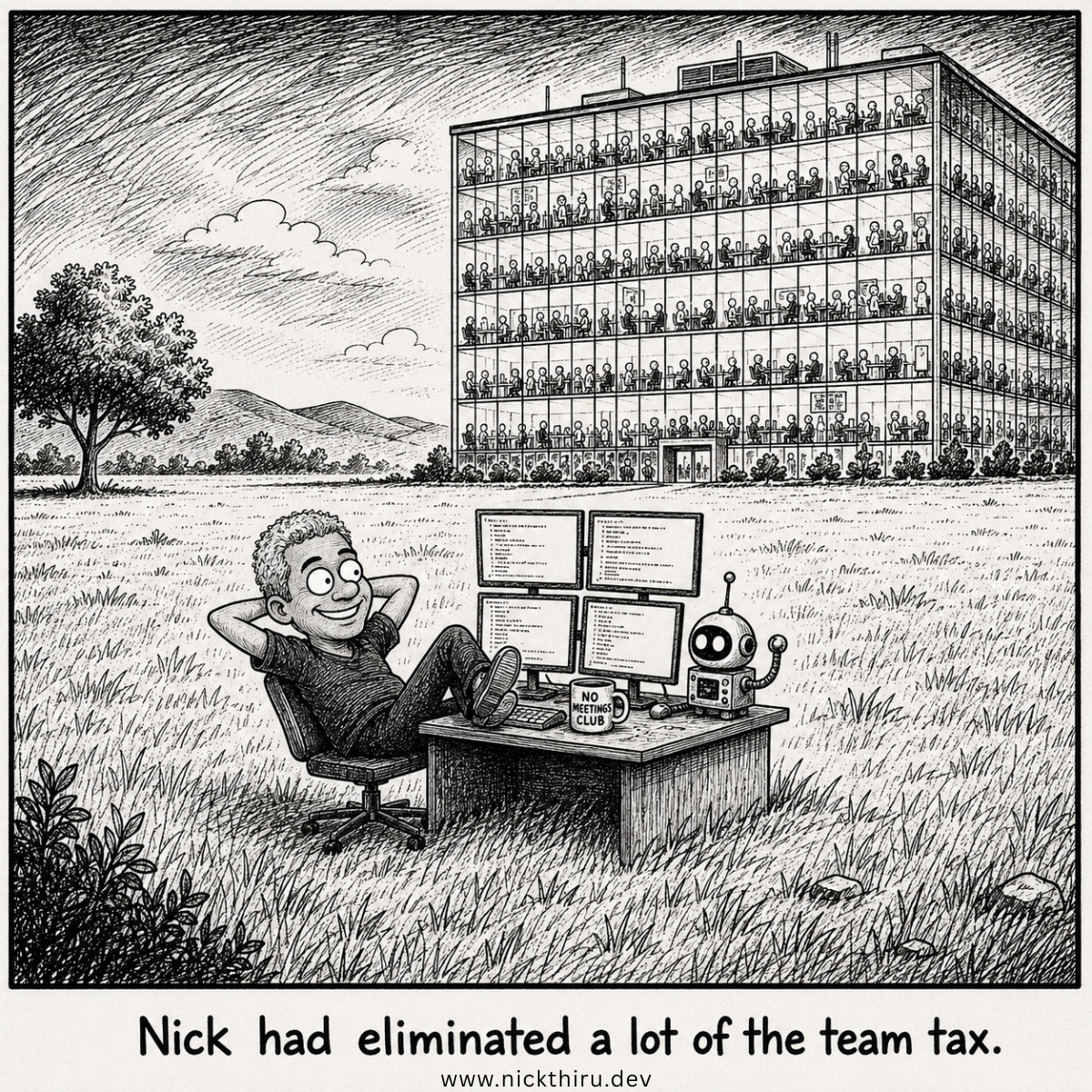
But AI eliminates a lot of the “team tax” work:
- drafting code + refactors (then I review)
- creating repeatable infrastructure (then I validate)
- documenting systems (so nothing lives only in my head)
- automating common support and ops tasks
The result isn’t “one person pretending to be a company.”
The result is a lean studio that can ship production-grade systems without the overhead of a full team.
What you get as a customer
This is the part that matters.
If you’re a customer (or potential customer), being solo changes the relationship in some ways that are actually positive. These flow directly from how the work is structured, not in spite of it.
1. Speed
No committees. No handoffs. No internal politics.
If you report a bug or request a feature, I can:
- evaluate it quickly
- ship it faster
- iterate based on your feedback immediately
2. Direct access
You’re not talking to:
- a support tier reading from a script
- a sales rep who doesn’t know the system
- a PM relaying messages back and forth
You’re talking to the builder.
That means when you ask “why does it work like this?” you get a real answer, including the tradeoffs.
3. Incentive alignment
My incentives are boring and simple:
- if the product works and keeps delivering value, I win
- if it doesn’t, I lose
I’m not optimizing for investor optics.
I’m optimizing for outcomes that matter to customers:
- reliability
- time saved
- fewer mistakes
- lower operational friction
4. Focus
No management overhead.
My time goes into:
- building
- fixing
- supporting
- shipping
That’s it.
5. Transparency
Being solo makes it easier to be honest.
No corporate PR filter. No “let me check with legal.”
Just: here’s what I’m building, here’s why, here’s what’s working, and here’s what isn’t.
The risks (and what I’m doing about them)
You don’t have to pretend the risks don’t exist.
I’d rather call them out directly.
“What if you get hit by a bus?”
Fair question.
This is how I mitigate it:
- Documentation: architecture docs, deployment guides, operational runbooks
- Infrastructure as Code: reproducible environments, no “mystery server” knowledge
- Standard patterns: nothing exotic that only I can maintain
- Transition plan: clear process for customer data + ongoing operations
“Can you handle support?”
Yes: with boundaries and systems.
- clear response windows
- automated monitoring so issues are caught early
- AI-assisted triage for common questions
- honest capacity management (if I can’t serve customers well, I pause growth)
Who this is for (and who it’s not)
You should work with me if:
- you value speed and direct access
- you’re operating lean (or you want to)
- you want a focused solution that solves one problem well
You should not work with me if:
- you need enterprise procurement + 24/7 phone support
- you want a generic platform that does everything
- you’re only comfortable with established vendors
I’m not trying to be everything to everyone.
I’m building for customers who care about outcomes.
The real lesson
The real lesson was this: “solo” is a structural description, not a capacity description. What AI augmentation changes isn’t the number of hours in the day. It’s the ratio of judgment work to execution work. A solo founder who is AI-augmented is doing nearly all judgment and very little execution overhead. That’s the only kind of work that actually compounds.
For small and medium businesses evaluating their options, that framing matters. The question isn’t “how big is the team?” It’s “how much of that team’s capacity is showing up in the outcome?”
Your Turn
If you’ve worked with a solo builder before: what made the difference between it feeling like a risk and feeling like an advantage? I’m genuinely curious whether it came down to trust, speed, or something else.
Have thoughts on this? I'd love to hear them. The conversation is happening on: